The DMK has Stalin and Stalin alone as the key campaigner. The rest of them all, including half-sister Kanimozhi, are tied down to their own constituencies while those like party treasurer and former minister S Duraimurugan, to those of their children's constituencies.
Ahead of VK Sasikala's return to Tamil Nadu on February 8, there are some important questions facing her. One, does she carry electoral weight more now than her brainchild AMMK had in the 2019 LS polls? Two, can she retain or build upon the five per cent vote-share from that time? And finally, is there space for Sasikala to retrieve, first within the AIADMK and then across the state, says N Sathiya Moorthy.
M K Stalin might not have his father's charisma, but he has learnt the ropes the long, hard way, says T E Narasimhan

While the DMK fears that the Congress with its poor strike rate will pull it down in the 2021 state elections, like it did five years ago, the ruling AIADMK is worried that the BJP may ultimately do a Bihar on it, relegating it to second place in Tamil Nadu, says N Sathiya Moorthy.

If the DMK under Stalin is unable to do well in the Lok Sabha elections, his personal and political standing in the party will be threatened. But if the party does well, Stalin is the next kingmaker to watch out for. T E Narasimhan and Aditi Phadnis report.
MK Stalin's ruling AIDMK rival does not thankfully face such problems as he did, but its problems could be worse if saner counsel does not prevail between now and the assembly polls, warns N Sathiya Moorthy.

At 70, going by hospital records made public, most age and health-related arguments put out against super-star Rajinikanth's entry into politics, before he withdrew citing a 2016 kidney-transplant, hold good for Sasikala, too, says N Sathiya Moorthy.
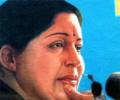
Inscrutable have been the ways of Tamil Nadu Chief Minister J Jayalalithaa. She is a political strategist and tactician rolled into one that her unpredictable ways have won the day for her - mostly, says N Sathiya Moorthy
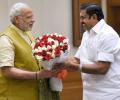
With the presidential elections over, the time has come for Prime Minister Modi to show Tamil Nadu that the state's interests are safe under him, says R Rajagopalan.
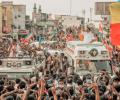
This time round, even 'petrol coupons' were reportedly distributed for those attending campaign rallies, especially those addressed by top leaders, cutting across party lines. If this owed to the rising cost of petrol and diesel -- which is a poll issue this time -- there were the customary coupons for 'quarter' (liquor bottle size) and non-vegetarian biryani. Some media reports claimed that some of these 'crowds' attended more than one political rally on the same day in the last week, and at times for rival political parties in adjoining constituencies or districts, says N Sathiya Moorthy.

An adverse judgement could have triggered a political realignment in Tamil Nadu and brought the ruling party perilously close to losing its majority in the state assembly whose effective strength is 232. Two seats are vacant.

The country is all set for the second round of elections on April 18 in the ongoing seven-phase Lok Sabha polls that will elect 543 members to the lower house of Parliament. Going to polls in the second phase will be 95 seats in 12 states and one Union Territory. Here is a look at some of the big names contesting in phase two of Lok Sabha elections.
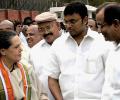
In the 2009 election, P Chindambaram the Sivaganga seat by a narrow margin. Then the Congress was in alliance with the ruling DMK. This time his son Karti is battling the seat with the alliance. India abstention at the UNHRC on an anti-Lanka resolution will further fuel Tamil anger against the Congress party. This leaves the finance minster sulking and his son facing an uphill political debut, says N Sathiya Moorthy.
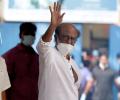
It looked as if the BJP was hoping to use Rajinikanth to press their seat-bargain with the AIADMK. Now with the Rajini bait gone, the question now is not how much the BJP would settle for, but how much the AIADMK would be ready to offer, notes N Sathiya Moorthy.

Sharad Pawar reckons that the NCP has value as a united, going concern, not as a gaggle of leaders in search of followers, notes Shreekant Sambrani.
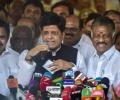
The announcement was made by AIADMK coordinator and deputy chief minister O Panneerselvam and Union Minister and senior BJP leader Piyush Goyal, party election in-charge for Tamil Nadu, who described it as a "mega alliance".
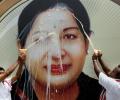
'The AIADMK has no Number Two, frankly it does not even have a Number Hundred and Two. There is the Numero Uno, and there is everybody else -- a point that was made very clear when Jayalalithaa made her ministers take the oath of office in unison on May 23. What, after all, was the point of having them do so individually when they lack individuality?'
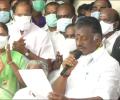
On the face of it, the first round has gone to Edappadi K Palaniswami. Not only has he been named chief ministerial candidate, that too by his one-time bete noire Panneerselvam, he also gets one member more in the steering committee than OPS. He can now hope to wean away one or more members of the OPS team in the steering committee just as he had done with other leaders in the latter's camp, post-reunification. That was also OPS's concern, says N Sathiya Moorthy.
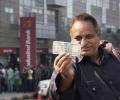
The sabre-rattling between parties on rival sides of the political divide over demonetisation showed no signs of softening on Saturday with the government accusing Congress of engaging in "fear mongering" and the latter hitting back calling the exercise a "not well thought out move" whose after-effects will last long.
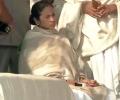
With her various overtures and right noises at the right time, Mamata is once again trying to reshape her image from being a regional leader to one with national appeal and acceptability. After all, the charge of building a Federal Front may also bring to the fore Mamata's chances to become prime minister in 2019.
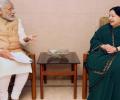
Though the 2019 alliance talks, if any, are a long way off, CM Jaya's current state of health and her long hospitalisation maybe a facilitating factor for the AIADMK to consider any BJP initiative favourably at the time, says N Sathiya Moorthy.
The presence of Sri Lankan President Mahinda Rajapaksa was not the only reason why Tamil Nadu Chief Minister J Jayalalithaa stayed away from Prime Minister Narendra Modi's swearing-in ceremony, says N Sathiya Moorthy.
NSG commandos, who guard some of the most high-risk VVIPs in the country, are set to sharpen their skills in this domain with the elite force asking the Special Protection Group to audit its performance and share expertise in better securing its protectees.
'Each of them is a setu (bridge) that links the government with the party, but their territories are different.'

Abstaining from voting on a UNHRC resolution on Sri Lanka was dictated as much by necessity and self-preservation as by a desire to place bilateralism at the front and centre of New Delhi's ties with Colombo, says Ramesh Ramachandran.
 © 2026 Rediff.com - Investor Information - Advertise with us - Disclaimer - Privacy Policy - Sitemap - Feedback - About us - Terms of use - Grievances